Why does a chimney leak? Use rain timing as a clue
A drip during rain or a stain afterward can help describe a leak. Water may travel through several interfaces before it appears, so the timing alone cannot select the repair.
- Family owned and run
- Free inspection first
- 100% satisfaction, guaranteed
- Locally owned and operated
Request a Free Inspection
Got it, thank you
Thanks for reaching out. We'll be in touch soon to book your free inspection.
Prefer the phone? Call (352) 675-6366
Chimney leaking when it rains: what the timing tells you
A drip that appears while rain is falling gives the inspector a useful timing clue. Water may enter through an opening or travel along concealed surfaces before reaching the firebox. The timing alone cannot show whether it passed through masonry or identify the entry point.
On the fast path, look first at an open flue with no cap, where rain falls right down the chimney, and a gap in the flashing, where water runs along the roof and slips behind the metal. A crown cracked right next to the flue tile can feed the fast path too, because the water only has a short trip to the inside of the flue.
A leak occurring during rain may make some observations easier to collect, but access, concealed paths and weather conditions can still complicate the investigation.
A stain that shows up a day later
A stain appearing after the rain has stopped can involve stored moisture or a delayed path through the assembly. Note when it appeared and how long it stayed wet. A delay does not prove that water travelled down through the masonry rather than another concealed route.
Brick and mortar are porous. The Brick Industry Association's guidance on water penetration treats brick walls as something that takes on water and has to release it, and a chimney stands out in the weather on every side. Open mortar joints, spalled brick faces and hairline crown cracks all let more water in than the brick can shed.
Outside, the slow path leaves a clue: white, powdery deposits on the brick called efflorescence. They're salts carried to the surface by water as it dries, a sign that water is moving through the chimney.
A leak that only comes with sideways rain
Is the chimney dry through ordinary rain and wet only after a hard, windy storm? Wind pushes water sideways into places that stay dry the rest of the time. A side face with open joints, a step flashing seam, a cap with too little overhang or the seams in a chase's siding can all stay quiet until the wind drives rain at them.
A strong, windy storm can drive rain sideways into a chimney far from the coast too. Those storms test the face turned toward the wind hardest, and that's the side where a hidden gap gives itself away. If your leak only shows after that kind of storm, tell the inspector which way the wind was blowing, since it narrows down which face to test.
How our pros confirm the source
Assessment starts with the history and accessible signs of moisture, then considers possible paths through the chimney and roof interfaces. A visible stain may be far from the entry point. The next step depends on access and what the initial observations establish.
A controlled water test may be appropriate in some investigations, but is not an automatic procedure or proof for every leak. The method needs to avoid causing damage and account for the building's condition. Leave testing on roofs or around electrical areas to suitable professionals.
A test that does not reproduce a leak cannot rule out every weather-dependent path. Explain what remains uncertain before selecting repairs, and arrange further investigation where needed rather than promising that one test establishes the whole chimney is dry.
Sorting a chimney leak or roof leak from the attic
Roof and chimney leaks can overlap in their symptoms. Moisture near a chimney in an accessible attic does not automatically establish which component failed. Do not enter unsafe attic spaces or approach wet wiring to follow a stain.
Water in the firebox may have several entry paths. Likewise, a dry area during one test does not exclude an intermittent leak. The assessment needs to connect the observations with the assembly rather than diagnosing solely from the room where water appears.
When the first observations do not establish the source, further roof or chimney assessment may be needed. A negative water test does not rule out every path. Agree on the next investigation and any division of work before authorizing a repair based on an uncertain diagnosis.
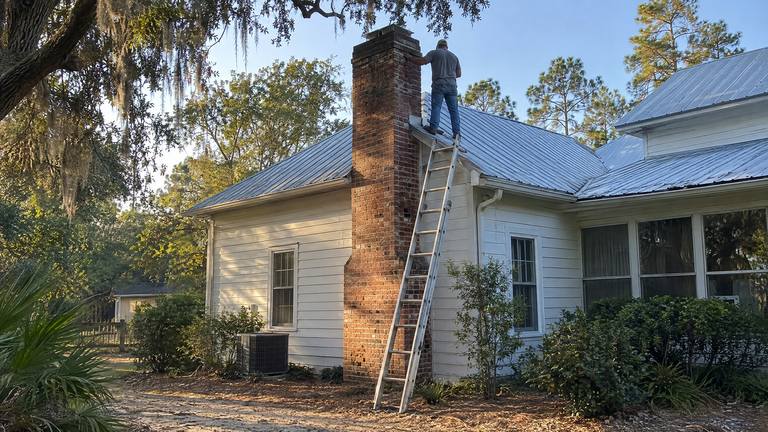
Chimney leak causes you can check from the ground
You won't find every cause from the yard, but binoculars will show you a lot.
- No cap, or a cap that's tilted, rusted through or missing its lid.
- Cracks across the crown, broken edges, or gray grit washing into the gutters.
- Flashing that's lifted, rusted, or held on only by caulk or tar.
- Open mortar joints, flaking brick faces or white deposits on the brick.
- On a factory-built chimney, rust streaks running down the siding below the chase cover.
- Water that shows up in dry weather, which can be condensation from a gas furnace or water heater venting into a flue that's too big or unlined for it.
Buckets tonight, then who to call for a chimney leak
Keep clear of wet electrical fittings, unstable finishes and sagging ceilings. Do not climb onto a wet roof or enter an unsafe attic. If water can be caught safely without approaching those hazards, protect nearby belongings while arranging help; immediate danger takes priority.
Until someone can look, keep a bucket and towels under the drip, move anything valuable away from the wall, and stay off the roof in wet weather. Tarping a chimney is roof work and isn't worth a fall.
Have us trace your leak
Tell us where moisture appears and the weather conditions when it occurs. A free inspection can assess accessible conditions and identify any further investigation required. Written estimates from our family-run team explain the proposed work, and your first service qualifies for a 10% discount. Discuss chimney leak repair at (352) 675-6366.

Proudly American
Proud to be a local, family-run company, and proud of every chimney and fireplace our pros look after.
FAQs
A few more quick answers
Can a new cap stop my leak?
It can if water is falling straight down an uncapped flue. If the water enters at the crown, soaks through the brick or runs behind the flashing, a cap can't reach it, which is why the source gets traced first.
Why does my fireplace smell after it rains?
Moisture interacting with old deposits can contribute to an odor, but smell alone does not identify the source. Arrange an assessment for recurring dampness or odors rather than assuming a sweep will resolve every cause.
Will waterproofing the brick fix a leak?
Only after the openings are repaired. A water repellent helps sound brick shed rain, but it can't close a split crown, gaps in the mortar or loose flashing.
How soon should a leak be looked at?
Arrange a prompt assessment so the entry path and any damage can be investigated. Our inspection and written estimate are free, with additional access or specialist work identified if needed. Call (352) 675-6366 to discuss the leak.
Chimney Guides
Guides from our local pros
-
-
-


Our Services
Have our pros take care of it


Ready for a free look from our pros?
Family run and locally owned, with free inspections and 100% satisfaction guaranteed. Reach us at (352) 675-6366.
Get a Free InspectionCall the Gainesville chimney experts
(352) 675-6366Inspection at no charge, price in writing before any work