Why does my fireplace smoke? Read when it happens
The timing of smoke helps describe the problem, but several causes can produce the same pattern. Stop using a fireplace that spills smoke and arrange an assessment.
- Family owned and run
- Free inspection first
- 100% satisfaction, guaranteed
- Locally owned and operated
Request a Free Inspection
Got it, thank you
Thanks for reaching out. We'll be in touch soon to book your free inspection.
Prefer the phone? Call (352) 675-6366
How chimney draft works in your house
A chimney works because hot gas is lighter than cool air. When the flue is warm, the column of hot gas inside it rises and pulls fresh air in through the fireplace opening behind it. That steady upward pull is the draft, and it's what carries smoke out of the room.
Anything that weakens that pull lets smoke spill out the front. A cold flue has no rising column yet. A blocked or undersized flue can't carry everything the fire makes. Wind at the top can push back down. And a house that's short on incoming air will try to get it from the easiest opening it can find, which may be the chimney itself.
Timing helps organize the history: note whether the problem occurred at startup, in wind or throughout a fire. Several faults can produce the same pattern, so the history needs to be checked against the condition of the appliance and venting.
Smoke only when you first light it
Smoke at startup can be associated with a cold flue, but it can also involve a damper problem, fuel or an obstruction. A fire that eventually draws is not proof that the earlier spill was harmless or that the system is clear.
Do not hold burning paper near the damper or light extra fires to force a draft. Leave the fireplace unused until the cause of recurring smoke is assessed. Once the system is suitable for use, follow its own starting instructions and approved fuel loading.
With the fireplace completely cold, use only the owner-accessible checks described in its manual. A handle position may not establish the actual damper position. A stuck or uncertain damper needs attention before lighting, without reaching into an unsafe opening.
Smoke only on windy days
If the fireplace draws well on calm evenings and puffs smoke into the room when the wind picks up, the wind is pushing down the chimney or creating pressure around the top. A taller part of the roof, a nearby roofline or big trees close to the chimney can all create swirling air right at the flue opening.
Chimney height, termination location and nearby roof geometry can affect draft. The applicable height and clearance requirements depend on the chimney system and building. An installer should assess these together; meeting a minimum dimension alone does not guarantee good draft in every wind.
A different approved termination or a change to the chimney may be considered after the cause is established. No cap is a universal cure. Any alteration must remain compatible with the chimney system and its installation requirements.
Smoke every time you burn
Smoke with every fire, even after the flue is warm and the air is still, points to something inside the system that's too tight or blocked. The first thing to rule out is a blockage: a nest, a pile of leaves, fallen mortar or tile on the smoke shelf, or heavy creosote narrowing the flue.
A mismatch between the fireplace opening and venting can contribute to spillage, as can damage in the smoke chamber or other flow restrictions. The repair needs to be selected from the actual configuration. A larger liner or smaller opening is not automatically the right answer.
These are the chimney draft problems a close look diagnoses. Some are fixed by cleaning, some by changing the opening, and some by relining or reshaping the smoke chamber.
When the house is starving for air
Chimney not drawing even though everything checks out? The house may be winning a tug-of-war with it. Kitchen and bathroom exhaust fans, a clothes dryer and some heating systems all push air out of the house. Every cubic foot they blow out gets drawn back in through some gap, and in a tightly sealed house the chimney becomes the intake.
Have a professional assess the interaction between the fireplace, the home's air supply and exhaust equipment. Do not light a test fire and open windows to see what happens. Any combustion-air change should be designed for the appliance and building.
Keep the fireplace out of use until the draft problem has been addressed. A window left open or an exhaust fan switched off does not establish that the system is safe under other conditions.
Fixes our pros can make
Once the cause is clear, the repair follows from it, and smoke coming out of the fireplace is a problem with a fix.
- Sweeping the flue and clearing the smoke shelf when creosote or debris is narrowing the passage.
- Addressing an obstruction after identifying its cause and any protected wildlife restrictions.
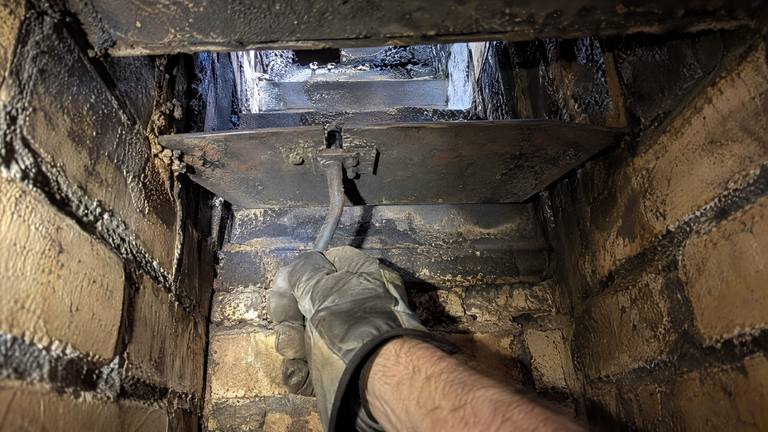
- Repairing or replacing a damper that won't open fully or seal.
- Parging a rough smoke chamber smooth so smoke flows cleanly into the flue.
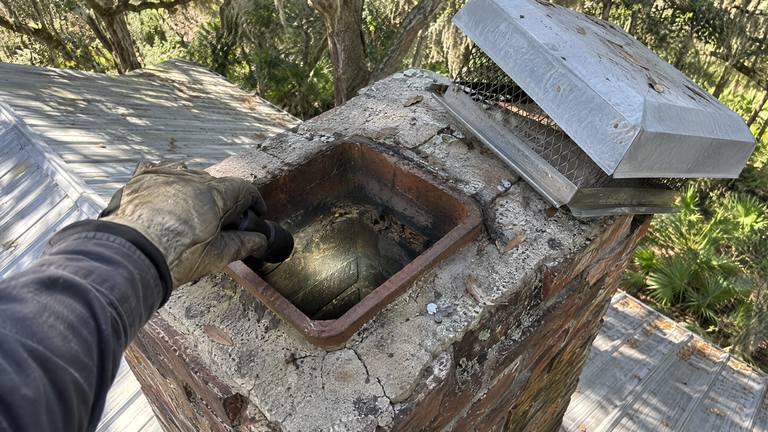
- Installing a cap suited to a windy site.
- Adding a glass or metal smoke guard across the top of the opening to reduce its size.
- Relining a flue that's the wrong size for the fireplace.
When the smoke won't clear
Smoke spilling indoors deserves attention even at startup. If it accumulates, an alarm sounds, or anyone becomes dizzy or ill, leave the building and call 911 from outside. Stay out until responders say it is safe to return.
Afterward, don't light another fire until the chimney has been checked.
Get your draft sorted
Recurring smoke is a reason to leave the fireplace unused and arrange help. Our local team offers free inspections and written repair estimates. Some draft concerns need further access or evaluation beyond an initial visit. A first service receives 10% off. Discuss chimney inspection at (352) 675-6366.
Proudly American
Locally owned, family run and working in homes across Alachua, Gilchrist, Levy, Bradford and Union counties.
FAQs
A few more quick answers
What causes a puff of smoke only while the fire catches?
Cold-start conditions are one possibility, but the same symptom can have other causes. Do not warm the damper with burning paper. Stop use and have recurring smoke assessed before another fire.
Could a new cap cure the smoke?
An approved cap may help a diagnosed wind-related problem. It cannot fix every blockage, sizing or room-pressure fault. Establish the cause before buying a replacement.
Does wet wood make a fireplace smoke?
Yes. Wet wood burns cool and smoky, and cool smoke rises more slowly, so more of it can spill into the room. Dry, seasoned wood helps with every other fix.
Can you tell what's wrong in one visit?
A free inspection can identify visible conditions and help define the next step. Some draft problems need further evaluation or access beyond the initial visit. Call (352) 675-6366 to discuss the symptoms without lighting a demonstration fire.
Chimney Guides
Guides from our local pros
-
-
-


Talk to a local chimney pro
Booking today? Your first service comes with a 10% discount, and the inspection costs you nothing.
Get a Free InspectionCall the Gainesville chimney experts
(352) 675-6366Inspection at no charge, price in writing before any work