Chimney anatomy, sorted by where you're standing
The yard, the attic and the hearth each show you a different set of chimney parts, and each part has its own way of telling you it's wearing out.
- Family owned and run
- Free inspection first
- 100% satisfaction, guaranteed
- Locally owned and operated
Request a Free Inspection
Got it, thank you
Thanks for reaching out. We'll be in touch soon to book your free inspection.
Prefer the phone? Call (352) 675-6366
From the yard, the top of the chimney
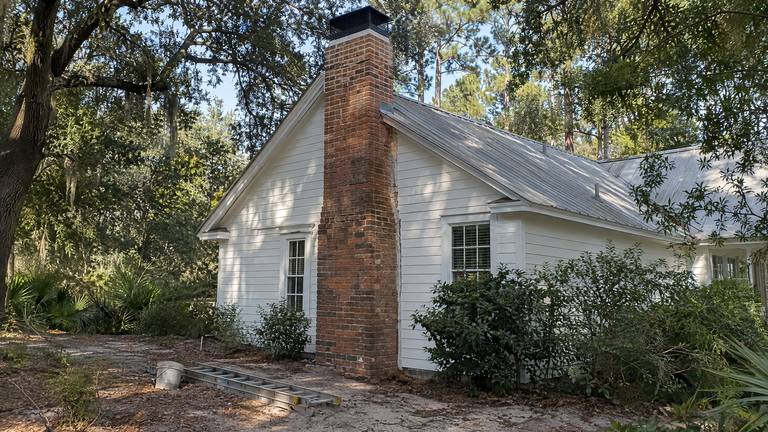
Step back until you can see the whole roofline, binoculars in hand if you own a pair. The first thing you'll spot is the cap, a screened metal hood perched over the flue opening. It stops rain from dropping straight down the flue. It also keeps out birds, squirrels and leaves. A cap that's rusted through, tilted or missing is doing none of that.
Below a cap, a masonry chimney may have a crown that directs water away from the brickwork. Cracks, a damaged edge or nearby grit are reasons to assess it, but do not prove where water is entering. Crown material and detailing vary.
Sticking up through the crown you may see the top of the flue liner, a square or round clay tile or a metal pipe. Chipped tile edges up there can be a sign that the liner below has seen heat damage or years of weather.
From the yard, the walls and the roof joint
Masonry chimneys use units and mortar joints that work together. Surface loss, missing mortar or mineral deposits can provide clues to condition. Joint shapes vary, so a coin-width gap or a recessed profile alone cannot decide whether repointing is the correct repair.
Where the chimney passes through the roof you'll find the flashing, the metal pieces that seal that joint. Step flashing is woven in with the shingles up both sides, an apron wraps the downhill face, and counter flashing is set into a mortar joint and laps down over the rest. On wide chimneys a small peaked roof called a cricket sits on the uphill side to split the water around it.
Rust, lifted edges, thick tar patches or flashing held on only by caulk point to the part most likely to explain a stain on your ceiling.
From the attic, the sides nobody looks at
Only observe attic areas that are safely accessible; do not enter unsafe spaces or step between supported walking surfaces. Staining near the chimney may indicate moisture, but its source requires assessment. Report suspected heat damage promptly and leave the fireplace unused.
Clearance between the chimney and combustible construction is an important installation detail. The required space depends on the system and applicable requirements. Do not fill a gap with insulation or foam, move framing or infer hidden clearances from one accessible point.
Keep an eye out for droppings, nesting material or a musty smell near the chimney, too. They can mean the cap has failed and something has found a way in.
The parts of a fireplace, seen from the hearth
Kneel at the hearth with a flashlight and you're looking at the working end of the system. The hearth is the fireproof floor beneath the fire. Its extension is the stretch that reaches out into the room to catch sparks and rolling embers.
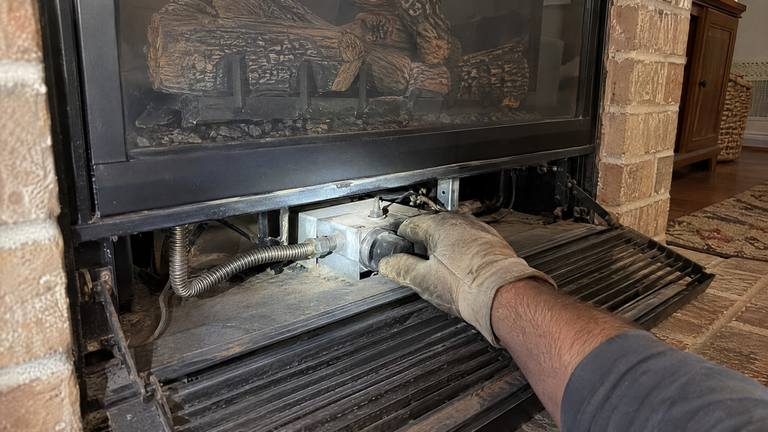
The firebox contains the fire and must use materials appropriate to its design. A damper controls an opening in some fireplaces, but operation differs for wood and gas arrangements. Damage or a stuck damper needs attention before use; vented gas logs may require a permanent opening.
In a masonry fireplace, the smoke chamber guides combustion products toward the flue. Its shape and surface condition can affect performance. Some fireplaces also have an ash dump and cleanout, which should be used only as the particular fireplace's instructions allow.
Inside the flue, the part you can't see
Inside the chimney runs the flue, the channel that takes smoke and gases up and out, and in a masonry chimney it's lined with clay tile or a metal liner. The liner protects the brick and the house framing from heat and from the acids in smoke, and it keeps the passage the right size for the fire it serves.
A view from the room or chimney top cannot reveal every liner surface or concealed condition. An inspection should state what was accessible and where further investigation is needed. Do not interpret a quick look as proof that the whole flue is sound.
Factory-built chimneys have their own parts list
Not every chimney is brick. A factory-built fireplace comes with its own listed metal chimney, and from the yard it looks like a framed box called a chase, finished in siding or stucco to match the house. On top sits a sheet-metal lid called a chase cover. A collar rings the metal flue pipe where it comes through, and a cap tops it.
Inside, the firebox is lined with refractory panels instead of firebrick. Factory-built units are tested as a system and installed exactly as their listing and the manufacturer's manual describe. Repairs use the maker's parts, and rust streaks on the siding below a chase cover are a strong hint that the cover is holding water.
Which clues mean stop, and which mean soon
Anything that touches the flue or the firebox walls means no fires until it's checked: broken tile in the firebox, a chimney leaning away from the house, or smoke showing up where it shouldn't. Crown cracks, flaking brick, rusty flashing and ceiling stains mean book a repair soon, because water damage grows with every storm.
A cap dent or white surface deposit may be a useful maintenance observation, but appearance alone does not establish urgency or safety. Report new damage and ask whether assessment is needed before further use.
Have our pros walk your chimney
Unsure which part needs attention? Book a free inspection with our local, family-run team. A written estimate can explain recommended work, access limits and any further evaluation. Your first service receives 10% off. Discuss chimney repair at (352) 675-6366.

Proudly American
Locally owned, family run and working in homes across Alachua, Gilchrist, Levy, Bradford and Union counties.
FAQs
More answers from our pros
Isn't the cap the same thing as the crown?
No. The cap is the metal hood with a screen that sits over the flue opening. The crown is the concrete slab underneath it that covers the brickwork and sheds water. Both keep rain out, in different ways.
Is there a smoke chamber in every fireplace?
A masonry fireplace does, since it's the funnel between the firebox and the flue. Factory-built fireplaces handle that transition inside the listed unit, so there's no separate masonry chamber to inspect or parge.
Can I check the flue liner myself?
A safe view from a cold fireplace may show only a limited area. It cannot rule out damage higher up or behind concealed construction. An inspection should identify its access limits and any additional evaluation needed.
Which part fails first on a brick chimney?
The weather-exposed cap, crown, walls and roof interfaces are potential maintenance points, but there is no universal first part to fail. Discuss the observed condition and inspection scope at (352) 675-6366.
Chimney Guides
Worth a read before you call
-
-
-


Our Services
Have our pros take care of it


Claim your 10% discount today
One call to (352) 675-6366 puts a free inspection from our local, family-run pros on your calendar.
Get a Free InspectionCall the Gainesville chimney experts
(352) 675-6366Inspection at no charge, price in writing before any work