From the switch to the flame, inside your gas fireplace
Flip a switch and a flame appears. Behind that are a valve, an ignition system, a safety sensor, a burner and a vent, and knowing them helps you make sense of any problem.
- Family owned and run
- Free inspection first
- 100% satisfaction, guaranteed
- Locally owned and operated
Request a Free Inspection
Got it, thank you
Thanks for reaching out. We'll be in touch soon to book your free inspection.
Prefer the phone? Call (352) 675-6366
Three jobs every gas fireplace does
Strip away the logs and the glass, and a gas fireplace is doing three things. It meters gas safely to a burner. It lights that gas and proves the flame is there. And it sends the exhaust somewhere, outside through a vent or, on vent-free units, into the room within strict limits.
These functions help explain the system, but symptoms can have several causes. A failure to light may involve supply, ignition or controls, while soot can involve the burner arrangement or venting. Understanding the parts helps describe a problem without diagnosing it by appearance alone.
Here's how each job gets done, starting where the gas comes in.
The gas valve, the gatekeeper
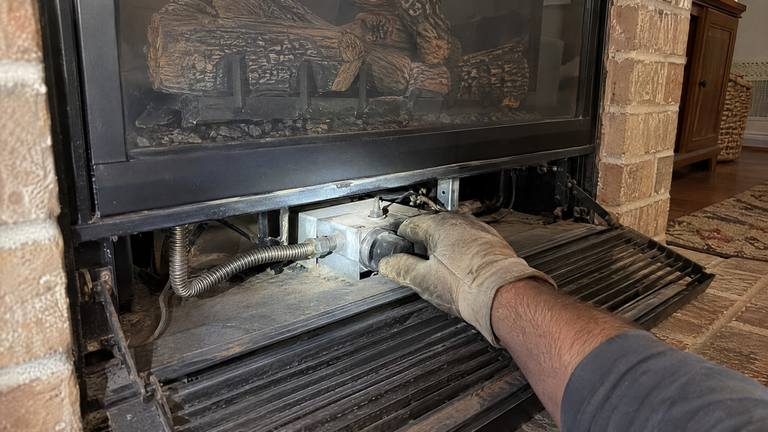
Gas reaches the fireplace through a supply line with its own manual shutoff, a small valve near the unit or behind the lower grille. From there it enters the control valve, the heart of the system. The valve regulates the pressure, feeds the pilot and opens or closes the flow to the main burner.
On many units the control valve has a knob with positions such as off, pilot and on, and a separate switch, remote or thermostat that tells it when to send gas to the main burner. Some valves also let you turn the flame height up or down.
The control system is designed to supervise ignition and stop fuel flow under specified fault conditions. Its sequence varies by appliance. Safety components must never be bypassed, and a suspected leak must be treated seriously even if the fireplace has shut itself off.
Two ways the flame gets lit
A standing pilot remains lit between calls for the main burner. Some such systems generate the small current needed by a millivolt gas control from the pilot's heat. Whether a complete fireplace can operate during an outage still depends on its model and accessories.
Many electronic systems ignite a pilot when heat is requested and then supervise the main burner. Some offer a continuous-pilot mode as well. Power may come from household wiring or an approved battery arrangement; the manual explains which modes are available.
The comparison is therefore model-specific. Check the ignition system and outage instructions before relying on a fireplace for heat during a power failure. A blower or other accessory may remain unavailable even if the burner can operate.
Thermopile vs thermocouple
Some standing-pilot systems use a thermocouple to provide a flame-related signal for the pilot safety control. Other arrangements differ. The parts diagram for the appliance identifies what is actually fitted; not every gas fireplace contains the same pair of sensors.
A thermopile generates electrical output from heat and can supply a millivolt control circuit in models designed that way. Electronic ignition may instead use different flame-sensing and control components. Measurements must be interpreted using the correct service instructions.
A pilot that will not remain lit, or a lit pilot with no main flame, does not identify one failed part. A technician may need to examine flame condition, connections, controls and supply before deciding what to replace.
The burner and the logs
The burner is a tube or a pan with rows of small ports where the gas mixes with air and burns. Around and on top of it sit ceramic logs, embers made of mineral wool or glowing granules, and sometimes glass or stones, all placed exactly as the manual shows.
That placement matters more than it looks. The flame has to reach the logs in certain spots and avoid others. Logs knocked out of position, or set back wrong after cleaning, push the flame where it wasn't designed to go, and that's a common source of soot on the logs and the glass.
Some units add a blower that pushes warm air from around the firebox into the room, which is a separate electric part with its own switch.
Where the exhaust goes
A direct-vent fireplace separates its combustion system from room air and uses approved paths for outdoor combustion air and exhaust. Some systems use a pipe within a pipe and some insert arrangements use separate liners. Vent components and routes must match the selected model.
A natural-vent fireplace uses room air and discharges outdoors through its specified vent. Vented decorative gas logs use a suitable fireplace and chimney. Their instructions can require a permanent minimum damper opening as well as a fully open damper during operation.
A vent-free unit releases combustion products indoors and has specific room and operating restrictions. Its oxygen depletion system is not a carbon monoxide detector. Suitability must be established for the exact appliance and location.
Gas fireplace parts that wear out
Knowing the gas fireplace parts that wear helps you describe a problem clearly when you call, and it helps you follow along when our specialist explains a finding.
- Thermocouples and thermopiles, which weaken with years of heat.
- Igniters and spark electrodes, which crack or drift out of position.
- Pilot assemblies, whose tiny openings clog with dust or spider webs.
- Remote receivers and their batteries.
- Glass gaskets, which flatten and leak over time.
- Blowers, whose bearings wear and get noisy.
Service from local gas specialists
Understanding the components can help you explain what changed when arranging service. Our family business offers a free inspection and written pricing for recommended repairs, with 10% off your first service and a 100% satisfaction guarantee. Call (352) 675-6366 to ask about gas fireplace repair.

Proudly American
Free inspections, 100% satisfaction guaranteed and a local family behind every job.
FAQs
A few more quick answers
Does a gas fireplace work when the power is out?
Some millivolt standing-pilot models can run the burner without household power, while other systems need electricity or an approved battery backup. Blowers and accessories can have separate power needs. Check the model's outage instructions before relying on it.
Is it worth shutting the pilot off between seasons?
Some owners do, to save the gas a pilot burns while the fireplace sits unused. Follow your manual to turn it off and relight it, and have the unit checked before you light it again after a long idle spell.
What's the difference between vented and vent-free?
Vented units send exhaust outside through a vent or chimney. Vent-free units burn in the room, with an oxygen depletion sensor and limits on room size set by the code and the listing.
Can you service any brand of gas fireplace?
Provide the make and model when calling (352) 675-6366. The team can confirm the service scope and check parts availability; this guide does not promise support or stocked components for every brand.
Chimney Guides
Guides from our local pros
-
-
-


Our Services
Have our pros take care of it

Let's get your chimney sorted out
Tell a local pro what you're seeing, and we'll find a free inspection slot that suits your schedule.
Get a Free InspectionCall the Gainesville chimney experts
(352) 675-6366Inspection at no charge, price in writing before any work