Why your chimney brick is flaking, and what fixes it
Water, the wrong mortar and coatings that seal moisture in are what peel the face off a Florida chimney's brick, and each one has its own fix.
- Family owned and run
- Free inspection first
- 100% satisfaction, guaranteed
- Locally owned and operated
Request a Free Inspection
Got it, thank you
Thanks for reaching out. We'll be in touch soon to book your free inspection.
Prefer the phone? Call (352) 675-6366
Flaking chimney brick: flakes on the roof and pits in the face
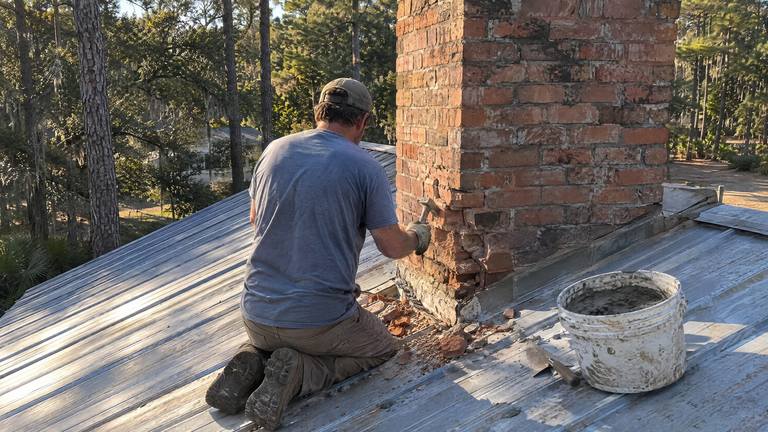
Found reddish flakes on the roof, or chips of brick in the flower bed below the chimney? Look up with binoculars. A spalled brick has shed a layer of its face, leaving a rough, pitted or crumbly surface that's a different color from the bricks around it.
Brick properties vary with the unit and how it was made; there is no universal hard skin over a soft core. Loss of surface material can change a brick's condition and exposure, but its color or the depth of one chip does not establish the strength of the remaining masonry.
Spalling isn't the same as the white powder you'll sometimes see on brick. That powder, called efflorescence, is mineral residue left as water dries. It can show up alongside spalling, since both come from water moving through the masonry, but on its own it doesn't damage the brick face.
What causes spalling brick on a chimney
Moisture is an important possible contributor. Rain can enter through defects at the crown, joints, flashing or other interfaces, while drying conditions vary around the chimney. Establishing those paths is part of assessing why a particular area is deteriorating.
Salts carried in moisture can crystallize within masonry pores and contribute to surface damage under some conditions. Brick Industry Association guidance discusses this risk in connection with moisture movement and coatings. Surface flakes alone cannot establish that salt activity is the cause.
The investigation should consider exposure, materials and previous repairs together. Correcting a confirmed moisture source may be part of the repair, but it is not proof that the damaged masonry can remain in place.
When an old repointing job is the culprit
Here's a cause that surprises people. Mortar is supposed to be the weaker, more breathable partner in a brick wall. When a past repair used a mortar that's harder and less porous than the brick, the wall's movement and its moisture both get forced through the brick instead of the joints.
Preservation Brief 2 describes exactly that: mortar stronger than the brick relieves stress through the brick, and mortar less permeable than the brick drives water and salts through it. The result shows up as cracked or spalled brick edges right along the joints, while the mortar itself looks fine.
Damage near joints can justify examining the earlier mortar, but its location does not prove incompatibility. A suitable repair mortar needs to work with the existing masonry in strength, movement and moisture behavior, not merely match its color or a generic mortar category.
Coatings that seal the water in
Coatings differ in how they absorb or release moisture. A coating that restricts drying can contribute to deterioration where water still enters the assembly. Check the existing finish and the masonry's condition before proposing removal or another coating.
A water repellent is not a substitute for repairing failed joints or resolving a leak. Suitability depends on the particular product, substrate and exposure, including its vapor transmission. Do not assume that every product described as breathable will suit every chimney.
Stopping the water first
A repair plan should address the damaged units and any contributing moisture paths together. The cap, crown, flashing and joints are possible inspection points, but other interfaces or concealed defects may also need investigation.
The order of work depends on access and structural condition. Moisture control and masonry replacement may be coordinated in one project; there is no rule that every water-related task must finish before any brick can be removed.
It's also worth knowing what caused the first round of damage. If a past repair used a hard mortar, the new joints around any replaced brick get a softer, matched mortar. If the chimney was painted or sealed with a film, our pros talk through whether that coating can come off safely or should be left and watched. Getting those choices right is what keeps the new brick from flaking in its turn.
When a flaked brick has to come out
Some superficial damage may be retained after assessment, while other units need repair or replacement. A brick's location low on the chimney or a thin-looking flake is not enough to decide. Stability, remaining section and adjacent masonry all matter.
Loose, deeply deteriorated or cracked units need prompt assessment, with the area below kept clear if material could fall. Replacement decisions account for the actual condition and structural role; being in a top course does not automatically dictate one repair method.
A replacement should be compatible with the existing masonry in more than appearance. Size, properties and condition matter alongside color and texture. Ask the estimate to explain the proposed match and any limits in available units, including whether salvaged material is appropriate.
Can spalled brick be patched?
A surface repair may be suitable for limited damage in a sound unit when the repair material is compatible. It does not restore every kind of deterioration or correct an unresolved moisture problem. Suitability needs an assessment rather than a promise based on patch depth.
Compare repair and replacement by the unit's condition, access and likely maintenance needs. Neither option is automatically cheaper over time or guaranteed to last. The estimate should explain why the proposed treatment suits this chimney.
Talk to our brick pros
Arrange an assessment of likely moisture sources and the condition of damaged brick. Repair choices depend on the cause, remaining masonry and compatible materials. We provide a written estimate for recommended repairs after the inspection. Call (352) 675-6366.

Proudly American
Proud to be a local, family-run company, and proud of every chimney and fireplace our pros look after.
FAQs
More answers from our pros
Can spalling chimney brick fall and hurt someone?
Falling fragments or loose masonry can injure people even when the surface loss appears shallow. Keep people away from an affected area and arrange a prompt assessment. Appearance from the ground does not establish stability.
Will sealing the brick stop spalling?
Only consider a coating after the condition and moisture sources have been assessed. Product compatibility and drying behavior matter. Paint or a water repellent cannot restore a weakened brick or substitute for repairs.
Can one spalled brick be replaced by itself?
Yes. A single brick can be cut out and replaced with a matching one, as long as the bricks around it are sound. Our pros check the surrounding bricks before quoting a single swap, and you can reach them at (352) 675-6366.
Why would flaking show up on one face and not the others?
That side may take the most wind-driven rain, sit under a leaking flashing seam, or have been repointed with a harder mortar than the rest. The pattern is a useful clue to the cause.
Chimney Guides
Worth a read before you call
-
-
-


Ask our pros about your fireplace
Pick a time for your free inspection, or talk it through with one of our pros now at (352) 675-6366.
Get a Free InspectionCall the Gainesville chimney experts
(352) 675-6366Inspection at no charge, price in writing before any work