Gas fireplace smells like gas: leave first, then get help
A suspected gas leak calls for leaving the building and contacting the gas utility or fire department from outside. Other fireplace odors also need a cause established before further use.
- Family owned and run
- Free inspection first
- 100% satisfaction, guaranteed
- Locally owned and operated
Request a Free Inspection
Got it, thank you
Thanks for reaching out. We'll be in touch soon to book your free inspection.
Prefer the phone? Call (352) 675-6366
Gas smell from fireplace: leave immediately
Catch a whiff of rotten eggs or sulfur around the fireplace, or in any room? Treat it as a gas leak. Don't light the fireplace or anything else, don't turn lights or appliances on or off, don't use a phone inside the house, and don't try to find the source yourself.
Get everyone outside and move away from the building. Call the gas utility or 911 from a safe location. Follow the responder's directions and do not re-enter to shut off the fireplace, collect belongings or investigate the source.
That order matters. Any spark, even from a light switch or a doorbell, can ignite gas that has collected in a room.
A suspected leak deserves the same response whether it seems to come from the fireplace or another appliance. Leave the investigation to the gas utility or emergency responders. Do not resume operation simply because the odor has disappeared.
Why gas has a smell at all
An odorant is added to fuel gas to make leaks easier to notice. Smell is a warning, not a reliable way to measure the amount of gas or exclude a leak. Take a suspected leak seriously even when the odor seems faint.
That means the smell is a signal worth trusting, even when it's faint. It also means the absence of a smell doesn't prove everything is fine. Carbon monoxide, a product of fuel that doesn't burn cleanly, has no smell at all, which is why working carbon monoxide alarms belong in every home with a gas fireplace.
If your household includes someone with a weak sense of smell, ask your gas utility about gas detectors, and keep the carbon monoxide alarms tested. Detectors and alarms don't replace the leave-now steps, but they add a warning that doesn't depend on anyone's nose.
A gas fireplace smell at lighting time
A gas smell during ignition is not a reason to wait for the next annual service. Follow the leave-now instructions above, including when the odor appears briefly and then disappears. Do not attempt another start to reproduce the smell.
A delayed ignition, unusual bang or repeated failure to light also needs attention before further operation. Tell the service provider what you already observed; there is no need to demonstrate the fault. If gas is suspected, emergency responders or the utility come first.
Hot paint and oily smells on a new unit
Some manufacturers describe temporary odors during the initial operation of a new appliance. The instructions are specific to that model and its installation. That explanation should not be used to dismiss a gas smell, an alarm, symptoms or an unfamiliar burning odor.
Only follow a break-in procedure after the installer has checked the installation and explained the exact manual instructions. Do not borrow another model's heat setting, run time or ventilation procedure, and do not run a suspect appliance to burn a smell away.
If an odor is outside what the manufacturer describes, stop using the appliance and arrange an assessment. For a possible gas leak, leave first and contact the utility or fire department from outside.
Dusty or burning smells after a long break
Dust may collect while a fireplace is unused, but an odor after a long break does not prove dust is the cause. Wiring, foreign material and combustion problems can also require attention. A seasonal service should precede use when condition or maintenance history is uncertain.
Do not wait an hour for an unexplained burning smell to clear. Stop operation if it is safe to do so and arrange service; smoke, an alarm, illness or suspected gas requires leaving and emergency help. Avoid trying to identify the problem by touching hot surfaces or opening service compartments.
Musty and smoky smells
A vented gas log set in a fireplace that once burned wood can bring out a smoky smell from old creosote still in the flue, especially on warm, damp days when air moves down the chimney. A sweep of the flue removes the source, and it's a step that belongs before gas logs go in.
Moisture and old deposits can contribute to musty or smoky odors, but the description alone does not identify their source. Have the chimney or vent condition assessed after any immediate gas or fire concern has been resolved.
When you are safely outside any suspected emergency, describe when the odor occurred and whether the appliance was operating. That history helps plan an assessment. It does not replace measurements or establish that a particular component has failed.
How a gas fireplace odor is checked
When a technician checks for a leak, they use a leak-detection solution that bubbles at a leak, or an electronic gas detector. The National Fuel Gas Code, NFPA 54, rules out matches, candles or any flame for finding leaks, since the method itself could ignite the gas.
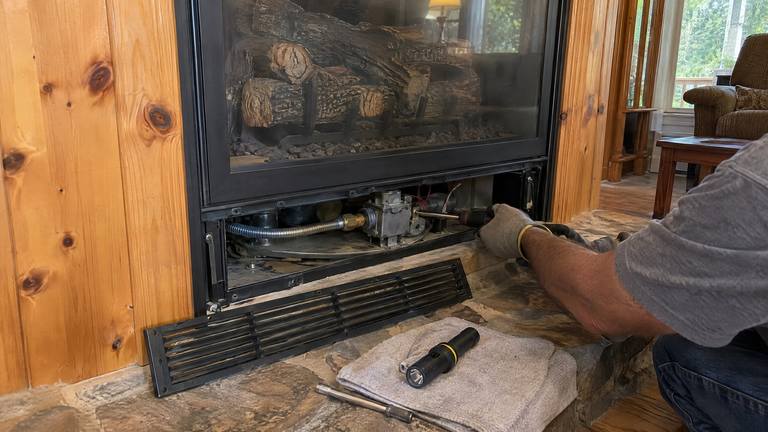
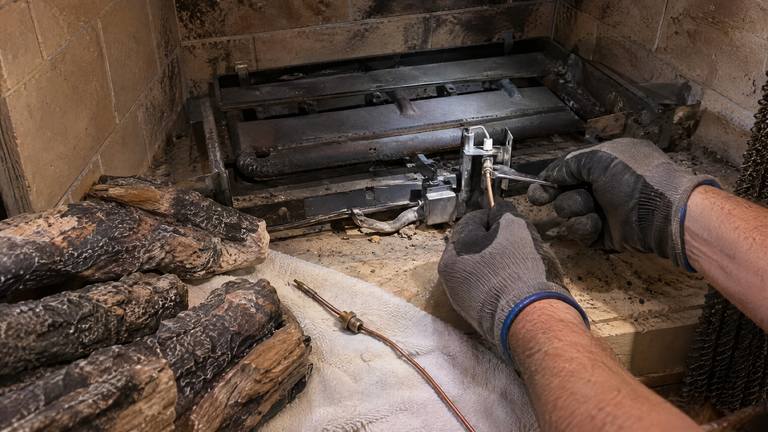
If the gas utility finds a leak in the supply line, a gas contractor repairs the line. Leaks at the fireplace's own valve, pilot or connections are part of servicing the fireplace, which is where our specialists come in once the utility has cleared the house.
Once the house is cleared, we'll handle the unit
After the gas utility or the fire department has cleared your home, the gas fireplace specialists at our local, family-run company service the unit, check its connections, pilot and burner, and quote any repair in writing. Your first service receives 10% off, with our workmanship warranty behind every part of it. Arrange gas fireplace repair through (352) 675-6366.

Proudly American
Free inspections, 100% satisfaction guaranteed and a local family behind every job.
FAQs
More answers from our pros
Is a faint gas odor when the fireplace lights normal?
Do not treat a faint or brief gas smell as normal. Leave without operating switches or using a phone inside, then call your gas utility or 911 from outside. Wait for clearance before returning.
When does the new-fireplace smell go away?
Use only the exact model's break-in instructions after the installation has been checked. Do not run an unfamiliar odor away or decide by smell that it is harmless. For suspected gas, leave without operating switches and call the utility or 911 from outside.
Can a gas fireplace give off carbon monoxide without a smell?
Yes. Carbon monoxide has no smell, which is why working CO alarms near sleeping areas and on each level matter in any home with a gas fireplace.
Do you service the fireplace after a leak is fixed?
Yes. Once the utility or the gas contractor has cleared the supply side, our specialists service the fireplace itself and check its connections. The number for that visit is (352) 675-6366.
Chimney Guides
Worth a read before you call
-
-
-


Reserve your free inspection today
Our local specialists take a free look and lay out your options clearly before any price is set.
Get a Free InspectionCall the Gainesville chimney experts
(352) 675-6366Inspection at no charge, price in writing before any work