When patching stops making sense for your chimney
A lot of chimney damage can be repaired. Here's how to tell when it can't, and why rebuilding only the top is the middle path for many chimneys.
- Family owned and run
- Free inspection first
- 100% satisfaction, guaranteed
- Locally owned and operated
Request a Free Inspection
Got it, thank you
Thanks for reaching out. We'll be in touch soon to book your free inspection.
Prefer the phone? Call (352) 675-6366
Chimney rebuild vs repair, in a sentence each
A repair fixes the parts that failed and keeps the rest of the masonry in place: new mortar in open joints, a few replaced bricks, a new crown, new flashing. A rebuild takes the masonry down to a point where it's solid and lays new brick from there up.
Both are real options. Which one fits comes down to how the chimney is standing, how deep the damage goes and how many times it's been patched already. Here's how our pros sort it out, starting with the easy cases.
Keep in mind that a chimney can need both. A rebuilt top can sit on a lower section that only needs a few joints repointed, and a good plan handles each part with the repair it actually needs.
Signs a repair will hold
Localized defects may be repairable when assessment confirms the surrounding masonry and structure are suitable. A chimney that appears straight from the ground can still have concealed damage. Open joints, spalling, crown cracks and flashing problems need their cause and extent established before choosing a repair.
Do not press or pull on brick to test stability. Visible movement, loose pieces or falling mortar call for keeping clear and arranging an assessment. Repointing decisions depend on the masonry's actual condition, not a homeowner hand test.
Repairs also make sense when the chimney has been cared for, with a working cap and a sound crown keeping water out of the top. That kind of chimney wears slowly, and fixing the worn spots buys many more years.
When movement changes the answer
A lean or a widening separation calls for structural assessment. Possible causes include foundation movement, connection problems or deterioration, and the required remedy depends on the cause. Do not assume that a cosmetic patch or a particular rebuild scope will solve it.
Cracks tell the story too. A crack that runs up through both brick and mortar in a straight line, or a stair-step crack that widens over time, points to the structure moving. Patching those cracks treats a symptom while the cause keeps working.
Stop using a leaning or unstable chimney and keep everyone clear of the potential fall area. Arrange urgent professional assessment. An immediate risk of collapse or danger to occupants calls for emergency services.
When water has gone deep
Years of leaks can leave a chimney worse inside than out. When our pros find loose brick several courses below the crown, mortar that's sandy all the way through the joint, or spalling on every face, the water has done its work deep in the wall.
At that point, raking and refilling joints can't restore the bond between brick and mortar, because the bricks themselves are loose in their beds. Relaying that section gives it a fresh bond, and the new masonry goes up with a proper crown and flashing so the water that caused the damage doesn't return.
The top that keeps crumbling
The section that rises above your roofline takes the most weather. It has no roof over it, it's wet on all four sides in every storm, and it carries the crown and the cap. It's no surprise that it wears first.
If that top section has been repointed, patched and sealed, and it still sheds brick and mortar onto the roof, you're paying for repairs that aren't holding. That's the pattern our pros look for when they ask how many times a chimney has already been fixed.
The middle path, rebuilding only the top
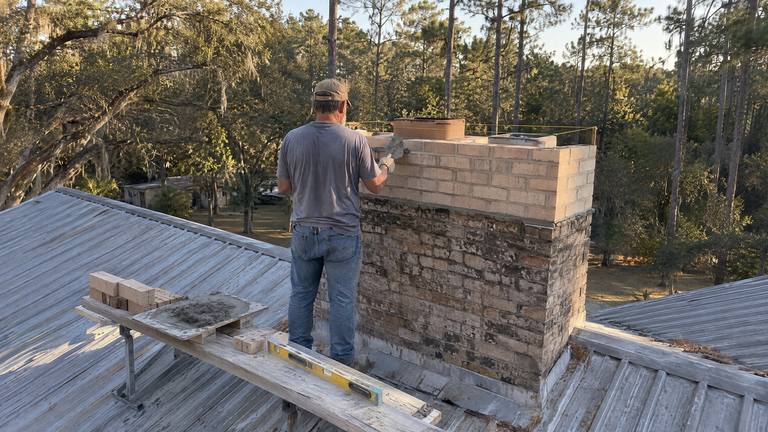
When to rebuild a chimney is not an all-or-nothing call. When the damage is concentrated above the roofline and the brick below is sound, a partial rebuild takes down only the failed top and relays it on solid masonry. The rest of the chimney stays as it is.
A top rebuild comes with a new crown, cap and flashing, and it's the time to extend a flue liner up through the new brick. It's a bigger job than a repair and a much smaller one than a full rebuild, and on many chimneys it's the repair that finally stops the cycle of patches.
Matching the new brick to the old is the main design question on a partial rebuild, since the seam sits right at the roofline where you'll see it.
Repairing a limited defect and rebuilding a deteriorated section involve different scopes. Compare what each estimate resolves, what remains in place and what further maintenance may be needed. Neither is automatically a one-visit project.
Rebuilding may address conditions that a surface repair cannot, but does not guarantee an end to maintenance or future leaks. The proposal should explain the structural scope, water management and any underlying cause that also needs correction.
Compare the feasible options by what each resolves, what remains in place and likely maintenance needs. Repeated failures are useful history, but do not establish by themselves that rebuilding is the better value.
What to ask whoever inspects it
Each of these deserves a clear answer before you sign anything.
- Is the chimney plumb, and if not, is it still moving?
- How far down does the loose brick or sandy mortar go?
- How many times has this section already been repaired?
- Is the flue liner sound, and will the rebuilt part need a new one?
- What would a repair cost now, and what would the next repair likely be?
Let our pros make the call with you
Still torn between patching and rebuilding? Our family-run pros look at your chimney from the crown to the attic without charge, then show you both options with written prices whenever both make sense for your house. Your first service receives a 10% discount, and our workmanship warranty stands behind it. Ask about a chimney rebuild on (352) 675-6366.

Proudly American
Free inspections, 100% satisfaction guaranteed and a local family behind every job.
FAQs
A few more quick answers
Is a rebuilt chimney stronger than a repaired one?
A rebuilt section has new brick and a fresh mortar bond throughout, so it starts over. A well-repaired chimney with sound brick can serve just as well, which is why the condition of the brick decides.
Can you push a leaning chimney back upright?
A leaning chimney needs structural assessment before a remedy is selected. Foundation, connection and masonry conditions can call for different work. Do not attempt to push or brace it yourself, and keep the potential fall area clear.
Is a permit part of a rebuild?
A rebuild is structural work, so plan on a permit. The building official for your address makes the final call, and your written quote shows the permit as its own line.
What if I'm selling the house soon?
A buyer's inspector will note a leaning or crumbling chimney. A clear written finding and a quote help you decide whether to fix it or price it into the sale. For a free look, dial (352) 675-6366.
Chimney Guides
Guides from our local pros
-
-
-


Our Services
Have our pros take care of it


Talk to a local chimney pro
Booking today? Your first service comes with a 10% discount, and the inspection costs you nothing.
Get a Free InspectionCall the Gainesville chimney experts
(352) 675-6366Inspection at no charge, price in writing before any work